
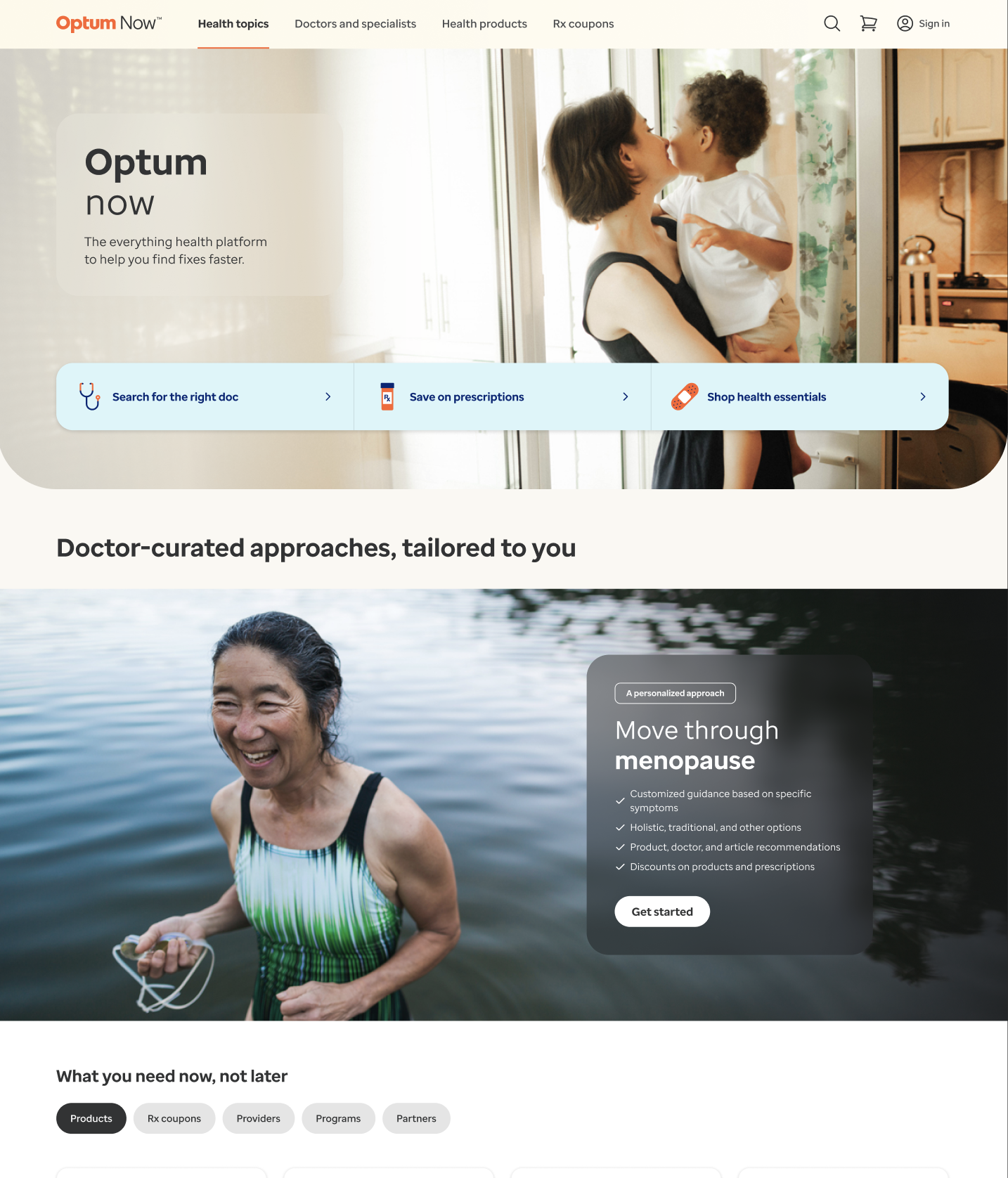
Redesigning Campaign Delivery Under a Compressed Timeline
How I helped Marketing and Creative redistribute work to deliver a high-priority Optum Now FSA/HSA campaign.
Challenge: An FSA/HSA campaign required substantial copy and design production within approximately one month, but the original delivery model exceeded the Creative Studio’s available capacity.
My role: I helped Lifecycle Marketing and Creative clarify the constraint, redistribute responsibilities, adjust scope, and resequence the work.
Outcome: Marketing took on more copy development, designers received production-ready content sooner, and the campaign successfully launched.
At a Glance
Approximately one month available for campaign production
Four primary partner groups: Lifecycle Marketing, Sales, Creative Studio, and Website
Work spanning copy development, design, campaign production, and digital experiences
A delivery model redesigned around actual team capacity
Successful launch during the late 2023 to early 2024 period
The Optum Now Environment
My Optum Now work began during 2023 and supported launch activity through late 2023 and into early 2024.
The broader portfolio included:
A consumer health content platform
Supporting products and digital experiences
Lifecycle marketing campaigns
Sales-related campaign needs
Website experiences associated with the brand
Creative assets supporting those channels
I worked most closely with Lifecycle Marketing, Sales, the Creative Studio, and Website teams.
The work involved multiple connected initiatives rather than one isolated deliverable. Marketing campaigns, creative production, platform content, and website experiences needed to move forward with enough alignment to create a coherent customer experience.
The Campaign Constraint
One of the clearest examples was an FSA/HSA campaign with a compressed production window of approximately one month.
The initial request required a significant amount of copy development and creative execution. Under the original workflow, the Creative Studio would have been responsible for more work than the team could reasonably complete within the available time.
The issue was whether the original scope, workflow, and staffing model could support any given campaign.
Moving forward without adjustment would have created a significant delivery risk.
What I Changed
Made the capacity problem explicit
I helped translate the studio’s workload into a clear project constraint:
The requested volume exceeded available creative capacity
Copy development would delay final design production
The timeline could not be protected without changing how the work was divided
This allowed the teams to address the tradeoff before the campaign became a late-stage emergency.
Redistributed responsibility
Marketing assumed greater responsibility for developing campaign copy.
That allowed the Creative Studio to focus its limited capacity on the work that most required specialized creative skills:
Final design
Production
Asset execution
Delivery across campaign formats
The solution was reallocating responsibilities based on where each team could contribute most effectively.
Resequenced the workflow
By providing designers with more complete content earlier, the team could begin final production sooner.
The revised sequence reduced the amount of unfinished upstream work entering design and created a clearer path through the compressed timeline.
Adjusted scope around the core objective
The teams evaluated:
Which deliverables were essential
Which responsibilities could shift
What could be simplified
What timeline was realistic
Where creative customization created the most value
The goal here was to protect the campaign’s most important business objective.
The Result
The FSA/HSA campaign successfully launched.
The revised approach helped:
Prevent limited Creative Studio capacity from becoming a launch blocker
Give designers more complete inputs earlier
Focus creative resources on final production
Improve coordination between Marketing and Creative
Align scope with the capacity actually available
Deliver the campaign within a compressed timeframe
The broader Optum Now content platform, supporting products, website experiences, and marketing initiatives also progressed successfully through the late 2023 and early 2024 launch period.
The most important lesson was that cross-functional delivery’s strongest operational decision is redesigning the work so the organization can still achieve the underlying objective.